
Volkswagen T-Cross

Volkswagen’s smallest SUV, the T-Cross, is likely to see a global unveil on October 25, 2018. While details of the European-spec T-Cross were already released, the company has now revealed more information about the slightly longer version that’s aimed initially at emerging markets like Brazil and China, with India likely to see local production a little later.
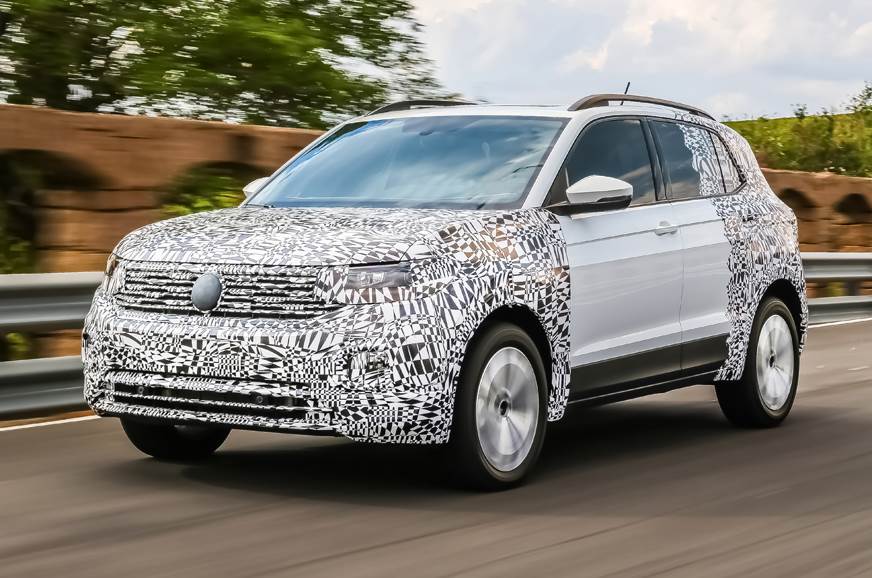
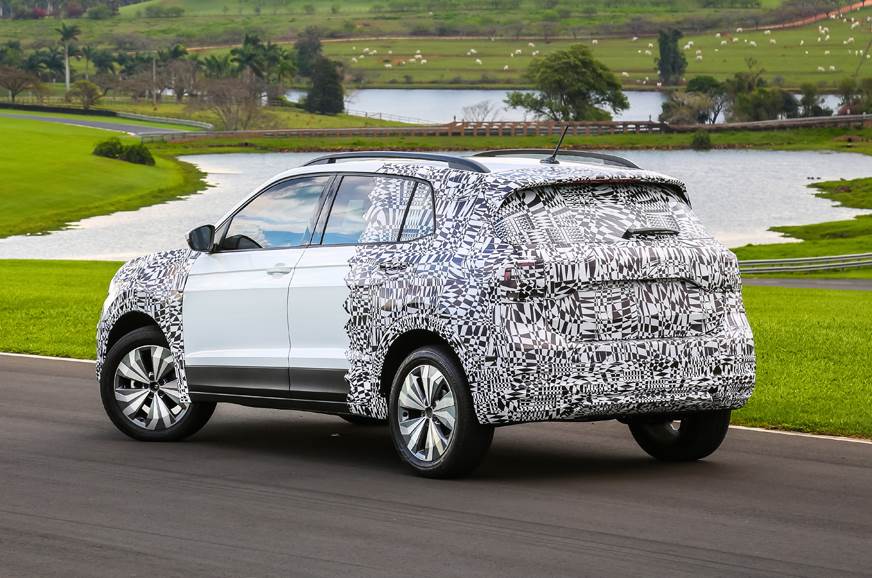
The T-Cross for emerging markets sits on Volkswagen’s slightly tweaked MQB A0 platform and, as reported by us earlier, it gets a longer wheelbase than its European cousin. The model is 4,199mm long, 1,568mm high and has a 2,651mm long wheelbase. In comparison, the Hyundai Creta is slightly longer, at 4,270mm and higher, at 1,780mm; but it has a slightly shorter wheelbase, at 2,590mm. The T-Cross has better cabin room than the Creta and also comes with rear seats that can be moved fore and aft in order to liberate more cargo or legroom. The SUV comes with dedicated rear AC vents and dual USB ports for the second row. Its 373-litre cargo room can be increased to as much as 420 litres, with the second row moved forward. In contrast, the Creta has 400 litres of luggage space. 
VW T-Cross dimensions
The SUV’s front styling is slightly different from its European counterpart, with subtle touches of chrome on the grille and on the tailgate. It has simpler LED daytime running lights, placed vertically, and higher trims are also expected to get full-LED headlamps.
On the inside, the car comes with ambient lighting, a 10.25-inch instrument display for higher trims, an 8.0-inch touchscreen and it will also have a dashboard and centre console design similar to the ones seen on the latest-gen Polo and Virtus sedan (neither of which is currently sold in India). The SUV’s also gets an optional interior package that allows buyers to select colour-coded bits for the dashboard and centre console.
As far as engines go, the South America-spec car will come with a 1.0-litre TSI petrol, a 1.4-litre TSI petrol and a 1.6-litre naturally-aspirated petrol engine. A choice between a 6-speed manual and a 6-speed automatic gearbox will be available, depending on the engine selected.
VW T-Cross interior sketch

What’s there for India?

While the above information is primarily for the model that will first be sold in South America and China, India will get a Skoda-badged SUV based on the T-Cross. The car for India will share multiple body panels, seats and interior bits, but will get its own exterior styling that will be similar to the Skoda Vision X SUV concept.
This new SUV will come to India only in 2020 and is expected to see competition from the Hyundai Creta, Renault Captur, Tata Harrier and the Nissan Kicks.

Comments

Post a Comment

Popular posts from this blog

Honda CB Unicorn 160 vs Suzuki Gixxer comparison

There is no replacement for displacement, as goes the old American saying, with which the rest of the world often nods in agreement. Increase in the number of cubic centimeters of fuel that our engines burn, seems only to be a pleasant idea to almost every petrolhead. More power, more torque and a healthier sounding grunt from the exhaust are the common expectations from larger engines. Honda Motorcycle and Scooter India (HMSI) has walked this same path, to add 10 extra cubic centimeters of capacity to the now proven CB Unicorn engine, to make the Honda CB Unicorn 160. FROLIC FASHION Although some of the features of the older CB Unicorn have been bettered, we’ve gone ahead and pitched it right in at the deep end, to face off against the very best in the segment to find out the exact degree to which this motorcycle has improved. So, in steps the Suzuki Gixxer, a Japanese-made premium commuter that’s fast rising to the top of its segment, with enough promise to overshadow all o...

2018 Lamborghini Urus India review, test drive

             On first introduction, it’s a recipe for intimidation. It’s claimed to be the fastest SUV in the world (0-100kph in 3.6sec and a top speed of 305kph puts it nearly in supercar territory), and it’s made by Lamborghini – creator of some of the most savage vehicles on the market. Things – as with any Lamborghini, for that matter – would be a lot less daunting if we were driving on a smooth European country road, a wide motorway, or even a race track. But today we’re driving the Urus on a narrow  ghat  road, as well as through some heavy Pune traffic. Perhaps the intention was to demonstrate that this is the first Lamborghini ever to go on sale in India that truly works in our conditions – but still, I doubt they accounted for rush hour. It’s requisitely mad to look at, employing as many ‘sporty’ design tropes to an SUV body style as possible – the only thing missing is a massive wing on the back; and somehow, it works. It’s ...

Land Rover Discovery Sport review

Two things. To start with, it’s Land Rover’s replacement for the popular and capable Freelander. It’s also the first of the models from Land Rover’s new Discovery sub-brand, one that will focus on utility in the same vein as the Range Rover line is about luxury. The Discovery Sport was shown as a concept last year and the production version’s styling doesn’t stray too far from the prototype. It’s smart, well proportioned and interesting but doesn’t have the show value of something like an Evoque. Still, there’s a certain honesty to the chunky shape which, if you think about it, more than links the Sport to the Freelander. The Sport is 91mm longer than its predecessor and also sits on a wheelbase that’s grown by 80mm. These increments, and the incorporation of a compact multi-link rear suspension, have allowed Land Rover to fit in a third row of seats, giving the Sport a big advantage over its five-seat competitors – the Audi Q5, BMW X3 and Volvo XC60. But Land Rover is being cau...