
Tata Harrier diesel engine details teased

Another day and another set of details from Tata Motors on its upcoming Harrier SUV. The latest communication from Tata Motors is centred around the Harrier’s engine. The engine has been christened the Kryotec. Tata says the name is inspired from ‘the Cryogenic rocket engine known for its power and reliability’.
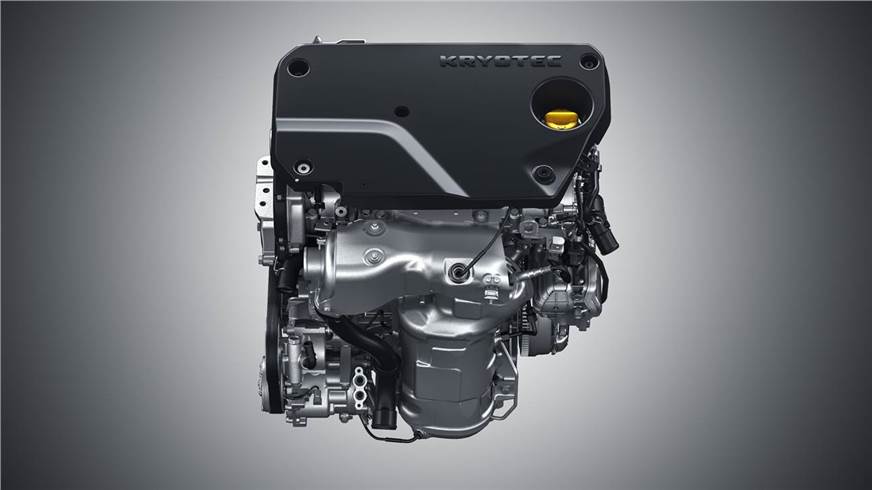
Tata Motors hasn’t revealed exact engine displacement or power and torque figures but as is widely known the engine is derived from Fiat’s four-cylinder Multijet 2.0 unit that powers the Jeep Compass. The engine will produce around 140hp on the Harrier though a larger seven seat version of the SUV that is due later will come with the 170hp version of the engine like that on the Jeep. On the Harrier, the engine will come with a six-speed manual gearbox as standard and will also be offered with the option of a Hyundai-sourced six-speed automatic.
Without delving into the finer points Tata Motors says the Harrier’s engine will feature an electronically controlled variable geometry turbocharger, a low friction valve train and an advanced EGR system. The engine, says Tata Motors, is benchmarked against global standards for performance and refinement.   
Tata Motors has also confirmed the Harrier will comes with multiple drive modes that will work in conjunction with ‘Terrain Response Modes of the ESP’. The Harrier will be built on Tata’s Omega Arc platform that has its roots in Land Rover’s D8 architecture, so it’s safe to expect all-wheel drive-equipped Harriers to be competent off-road.
Tata Motors has already teased the design and styling of the new SUV and shared details of what to expect on the inside too. The production-spec Harrier itself has been caught testing repeatedly just about everywhere, in the Himalayas and even at the Kari Motor Speedway.
The Tata Harrier is set to go on sale in January 2019, and will take on the upcoming Kia SP-based SUV and Nissan Kicks, in addition to the Hyundai Creta and Renault Captur already on sale.

Comments

Popular posts from this blog

Honda CB Unicorn 160 vs Suzuki Gixxer comparison

There is no replacement for displacement, as goes the old American saying, with which the rest of the world often nods in agreement. Increase in the number of cubic centimeters of fuel that our engines burn, seems only to be a pleasant idea to almost every petrolhead. More power, more torque and a healthier sounding grunt from the exhaust are the common expectations from larger engines. Honda Motorcycle and Scooter India (HMSI) has walked this same path, to add 10 extra cubic centimeters of capacity to the now proven CB Unicorn engine, to make the Honda CB Unicorn 160. FROLIC FASHION Although some of the features of the older CB Unicorn have been bettered, we’ve gone ahead and pitched it right in at the deep end, to face off against the very best in the segment to find out the exact degree to which this motorcycle has improved. So, in steps the Suzuki Gixxer, a Japanese-made premium commuter that’s fast rising to the top of its segment, with enough promise to overshadow all o...

ABS brakes mandatory for two-wheelers soon

The Government Of India is paying some attention to road safety issues in the country. Keeping road safety in mind, the GOI is working on making the anti-lock braking system mandatory for all two-wheelers above the engine capacity of 125cc. This is a big step forward in the right direction, as over 70 percent of accidents that take place in India involve two-wheelers. Nitin Gadkari, Road Transport Minister has just recently approved this proposal, and is working on implementing it. Gadkari, who was recently present at the Bloomberg TV Autocar India Awards 2015 also talked about his plans of building safer roads for India. This is absolutely necessary, keeping in mind that as per data collected in 2013, 39,353 people were killed on Indian roads while riding two-wheelers. While the time frame for the Indian government to enforce this law remains undecided, sources say that safer roads for India aren't too far away.   

Volkswagen T-Cross

Volkswagen’s smallest SUV, the T-Cross, is likely to see a global unveil on October 25, 2018. While details of the European-spec T-Cross were already released, the company has now revealed more information about the slightly longer version that’s aimed initially at emerging markets like Brazil and China, with India likely to see local production a little later. The T-Cross for emerging markets sits on Volkswagen’s slightly tweaked MQB A0 platform and,  as reported by us earlier, it gets a longer wheelbase than its European cousin . The model is 4,199mm long, 1,568mm high and has a 2,651mm long wheelbase. In comparison, the Hyundai Creta is slightly longer, at 4,270mm and higher, at 1,780mm; but it has a slightly shorter wheelbase, at 2,590mm. The T-Cross has better cabin room than the Creta and also comes with rear seats that can be moved fore and aft in order to liberate more cargo or legroom. The SUV comes with dedicated rear AC vents and dual USB ports for the second row...