
Renault EZ-Ultimo revealed

Renault has unveiled the EZ-Ultimo, its all-electric, self-driving luxury limousine concept designed for short journeys. The concept completes a trio of autonomous vehicles from the French car maker showcasing its vision of the future.
The company believes the vehicle could be used by private individuals and by high-end brands to transport clients between hotels and airports, for instance. It could also be used as an app-controlled ride-hailing vehicle.
The EZ-Ultimo has a 499-km range and features level-four autonomy, which allows a car to drive itself in most scenarios. It seats up to three people and is 5.8m long, a similar length to Rolls-Royce’s Phantom.
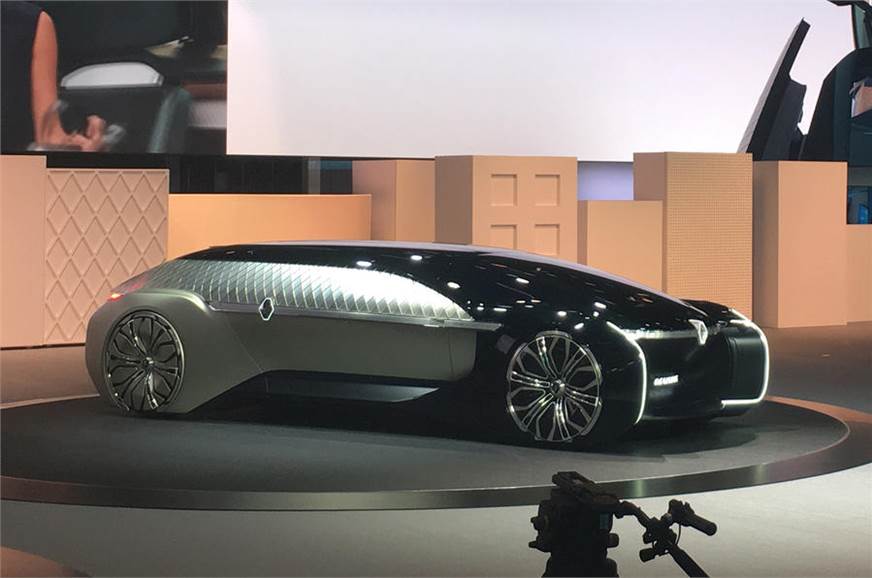
It is the third autonomous concept unveiled by Renault this year, with the firm aiming to show the variety of ways self-driving cars might be used by society. The six-seat EZ-Go, conceived as an urban vehicle for ride sharing, was displayed at the Geneva motor show in March. It was followed last month by the EZ-Pro, a take on a delivery van. The EZ-Pro focuses on ‘last mile’ deliveries but is also adaptable to other businesses. For example, it can be used as a catering van.
The EZ-Ultimo sits at the top of the family and “imagines unique, premium services accessible to anyone”. Rather than a ride-sharing vehicle that might carry 10 passengers, the EZ-Ultimo is intended for “private travel.”

It has a sliding side door, with the glass section opening upwards, to allow easy entry and exit. The interior is designed like a lounge and is inspired by Renault’s pre-war models in celebration of its 120th anniversary.
A large armchair and a deep two-person bench are covered in velvet; there is parquet flooring, too.
Light and sound are controlled by rotating knobs that appear from two consoles when required. There is permanent Wi-Fi, wireless charging pads for smartphones and an iPad-style tablet for accessing the car’s services.
Of the three concepts, the EZ-Go and EZ-Pro are the most plausible for production. “The first stage is EZ-Go production,” said concept car boss Stéphane Janin. “I can’t say when, but it’s going to happen.

However, he said their systems were likely to be used on “conventional-looking” cars first. “If you want to change the design [to the EZ concept cars], people need to feel safe with the technology first,” Janin explained. “New technology and new design is too much. We had similar conversations on electric vehicles before we launched the [electric] Zoe.”
Renault is currently testing adapted Zoes with level-four autonomy on set loops in two locations in France.
By the end of the year, the public will be able to use the cars as part of the trial, albeit with a driver behind the wheel for safety reasons. Renault is aiming to offer such technology on production models by 2022.

Comments

Popular posts from this blog

Honda CB Unicorn 160 vs Suzuki Gixxer comparison

There is no replacement for displacement, as goes the old American saying, with which the rest of the world often nods in agreement. Increase in the number of cubic centimeters of fuel that our engines burn, seems only to be a pleasant idea to almost every petrolhead. More power, more torque and a healthier sounding grunt from the exhaust are the common expectations from larger engines. Honda Motorcycle and Scooter India (HMSI) has walked this same path, to add 10 extra cubic centimeters of capacity to the now proven CB Unicorn engine, to make the Honda CB Unicorn 160. FROLIC FASHION Although some of the features of the older CB Unicorn have been bettered, we’ve gone ahead and pitched it right in at the deep end, to face off against the very best in the segment to find out the exact degree to which this motorcycle has improved. So, in steps the Suzuki Gixxer, a Japanese-made premium commuter that’s fast rising to the top of its segment, with enough promise to overshadow all o...

2018 Lamborghini Urus India review, test drive

             On first introduction, it’s a recipe for intimidation. It’s claimed to be the fastest SUV in the world (0-100kph in 3.6sec and a top speed of 305kph puts it nearly in supercar territory), and it’s made by Lamborghini – creator of some of the most savage vehicles on the market. Things – as with any Lamborghini, for that matter – would be a lot less daunting if we were driving on a smooth European country road, a wide motorway, or even a race track. But today we’re driving the Urus on a narrow  ghat  road, as well as through some heavy Pune traffic. Perhaps the intention was to demonstrate that this is the first Lamborghini ever to go on sale in India that truly works in our conditions – but still, I doubt they accounted for rush hour. It’s requisitely mad to look at, employing as many ‘sporty’ design tropes to an SUV body style as possible – the only thing missing is a massive wing on the back; and somehow, it works. It’s ...

ABS brakes mandatory for two-wheelers soon

The Government Of India is paying some attention to road safety issues in the country. Keeping road safety in mind, the GOI is working on making the anti-lock braking system mandatory for all two-wheelers above the engine capacity of 125cc. This is a big step forward in the right direction, as over 70 percent of accidents that take place in India involve two-wheelers. Nitin Gadkari, Road Transport Minister has just recently approved this proposal, and is working on implementing it. Gadkari, who was recently present at the Bloomberg TV Autocar India Awards 2015 also talked about his plans of building safer roads for India. This is absolutely necessary, keeping in mind that as per data collected in 2013, 39,353 people were killed on Indian roads while riding two-wheelers. While the time frame for the Indian government to enforce this law remains undecided, sources say that safer roads for India aren't too far away.