
Maruti Suzuki to supply Ciaz, Ertiga to Toyota in India

Suzuki and Toyota have already partnered for the supply of certain models in India and Africa and also the popularisation of electric models in our market. The two Japanese manufacturers have today announced they are looking to expand the scope of their cooperation. As per a joint release from the carmakers, Maruti Suzuki will supply the Ciaz midsize sedan and Ertiga MPV to Toyota in India and Africa. While there is no timeline as to when the Toyota versions of the Maruti models will go on sale, the carmakers have confirmed Toyota’s version of the Maruti Suzuki Vitara Brezza will be manufactured at the Toyota Kirloskar Motor plant in Bidadi, Karnataka from 2022.
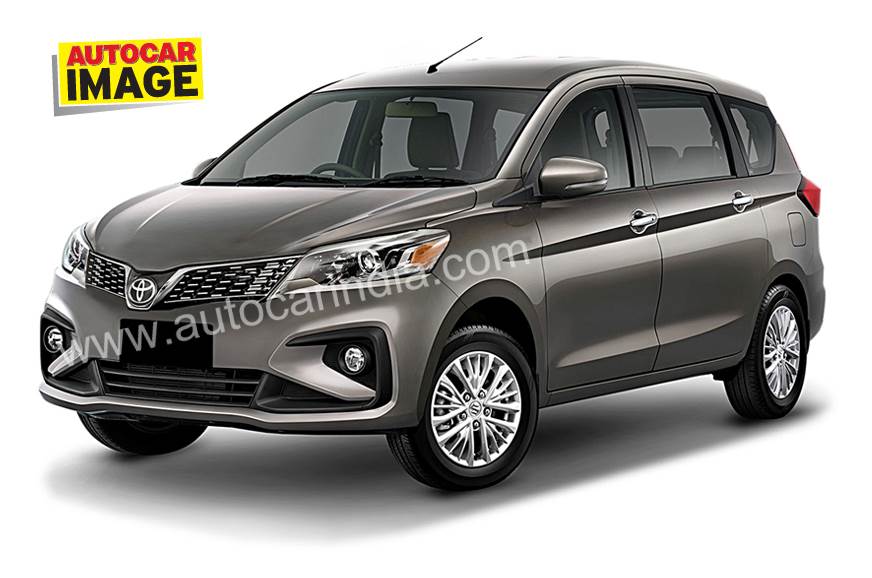
Computer generated image

 As reported already, Toyota’s version of the Maruti Suzuki Baleno hatchback will go on sale within 2019 as the first model to come from the partnership. As per the terms of the partnership, Toyota will also supply the Corolla Altis to Maruti Suzuki though it is expected that this will happen only once the next-gen version of the sedan goes on sale post 2020.
The latest announcement also mentions plans to leverage Suzuki’s expertise in developing vehicles in India. While details are limited at the moment, the two carmakers will cooperate to develop a new Toyota C-segment MPV that will be supplied to Suzuki. It will be interesting to see how the new MPV is positioned vis-à-vis the Ertiga.
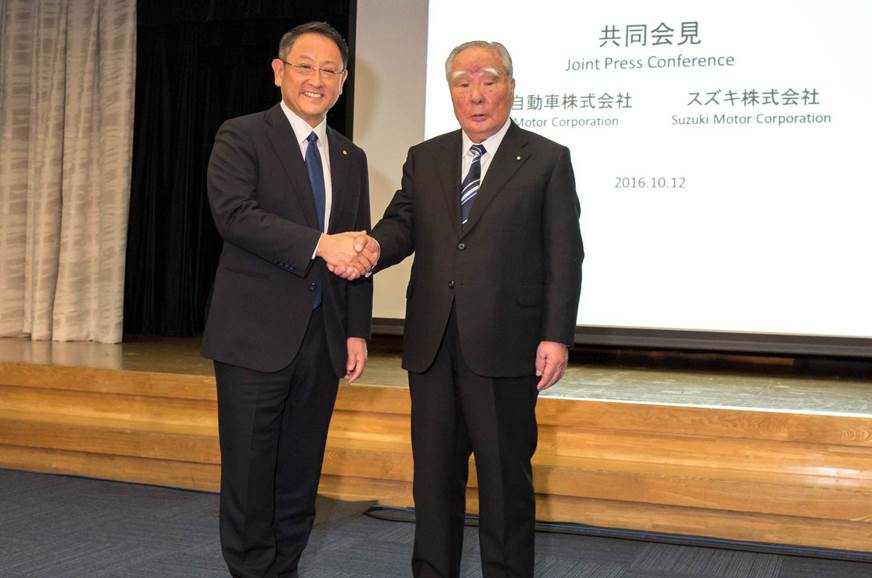
(L-R) Toyota president Akio Toyoda and Osamu Suzuki, chai...

The two manufacturers will also make a big push for hybrid electric vehicles with the local procurement of hybrid systems, engines and batteries. Toyota will supply its hybrid system to Suzuki too. Interetingly, Suzuki, Toshiba and Denso have already invested in a battery plant in Gujarat.
Outside of India, Toyota and Suzuki will partner in Europe. Toyota will adopt Suzuki’s small engines for its compact cars while Toyota will supply two electrified vehicles – the RAV4 and the Corolla estate – to Suzuki.
While the cooperation Toyota and Suzuki is far-reaching and brings with it shared costs, the carmakers have underlined they will compete fairly and freely. In his statement, Toyota President Akio Toyoda said “The expansion of our business partnership will give us the competitive edge we will need to survive this once-in-a-century period of profound transformation.”


Comments

Popular posts from this blog

Honda CB Unicorn 160 vs Suzuki Gixxer comparison

There is no replacement for displacement, as goes the old American saying, with which the rest of the world often nods in agreement. Increase in the number of cubic centimeters of fuel that our engines burn, seems only to be a pleasant idea to almost every petrolhead. More power, more torque and a healthier sounding grunt from the exhaust are the common expectations from larger engines. Honda Motorcycle and Scooter India (HMSI) has walked this same path, to add 10 extra cubic centimeters of capacity to the now proven CB Unicorn engine, to make the Honda CB Unicorn 160. FROLIC FASHION Although some of the features of the older CB Unicorn have been bettered, we’ve gone ahead and pitched it right in at the deep end, to face off against the very best in the segment to find out the exact degree to which this motorcycle has improved. So, in steps the Suzuki Gixxer, a Japanese-made premium commuter that’s fast rising to the top of its segment, with enough promise to overshadow all o...

2018 Lamborghini Urus India review, test drive

             On first introduction, it’s a recipe for intimidation. It’s claimed to be the fastest SUV in the world (0-100kph in 3.6sec and a top speed of 305kph puts it nearly in supercar territory), and it’s made by Lamborghini – creator of some of the most savage vehicles on the market. Things – as with any Lamborghini, for that matter – would be a lot less daunting if we were driving on a smooth European country road, a wide motorway, or even a race track. But today we’re driving the Urus on a narrow  ghat  road, as well as through some heavy Pune traffic. Perhaps the intention was to demonstrate that this is the first Lamborghini ever to go on sale in India that truly works in our conditions – but still, I doubt they accounted for rush hour. It’s requisitely mad to look at, employing as many ‘sporty’ design tropes to an SUV body style as possible – the only thing missing is a massive wing on the back; and somehow, it works. It’s ...

ABS brakes mandatory for two-wheelers soon

The Government Of India is paying some attention to road safety issues in the country. Keeping road safety in mind, the GOI is working on making the anti-lock braking system mandatory for all two-wheelers above the engine capacity of 125cc. This is a big step forward in the right direction, as over 70 percent of accidents that take place in India involve two-wheelers. Nitin Gadkari, Road Transport Minister has just recently approved this proposal, and is working on implementing it. Gadkari, who was recently present at the Bloomberg TV Autocar India Awards 2015 also talked about his plans of building safer roads for India. This is absolutely necessary, keeping in mind that as per data collected in 2013, 39,353 people were killed on Indian roads while riding two-wheelers. While the time frame for the Indian government to enforce this law remains undecided, sources say that safer roads for India aren't too far away.